
Ready to turn your SaaS idea into the next big thing in 2026 The secret isn’t building more, it’s building smarter. The path to software success starts with understanding the mvp saas approach.
This guide will demystify every step, from idea validation and market research to prototyping, launch, and scaling. The SaaS market is projected to surpass $1 trillion by 2032, yet most products fail due to lack of validation and overbuilding.
Discover why building an MVP is the fastest, most cost-effective way to test your vision. Get ready to learn actionable steps, real-world examples, and strategies for 2026. Start your journey here.
Understanding MVP in SaaS: Definition, Benefits & 2026 Trends
Launching a successful SaaS product in 2026 demands more than rapid development. It requires focus, validation, and adaptability right from the start. Understanding what an MVP means for SaaS—and why it is essential for today's founders—lays the groundwork for building smarter, not just faster.
What is a SaaS MVP?
A SaaS MVP, or Minimum Viable Product, is the simplest version of your software that delivers core value to users. It includes only the essential features needed to solve a specific problem and gather real-world feedback. Unlike a prototype, which is often non-functional or only demonstrates design, an MVP is a working product that customers can actually use.
The key distinction between a minimum viable and a minimum sellable product is purpose. A minimum viable product aims to validate assumptions and learn about user needs, while a minimum sellable product is ready for broader commercialization. In the mvp saas approach, the focus is on learning and iterating, not just shipping quickly. For a deeper dive into core strategies and real-world examples, review these MVP strategies for SaaS startups.
Key Benefits of Building an MVP
Building an mvp saas offers several strategic advantages for founders:
- Reduces risk by confirming user demand before major investments.
- Accelerates time-to-market, helping you reach early adopters and beat competitors.
- Optimizes resource allocation so you only build what matters most.
- Strengthens investor confidence with real proof of traction.
- Enables fast iteration based on real user data.
- Prevents overbuilding and wasted resources, as highlighted by industry leaders.
By focusing on the mvp saas approach, you can avoid the common pitfalls of over-engineering and misaligned features. This method ensures that every development cycle adds measurable value, making it easier to pivot or double down based on evidence. Iterative improvement is not just efficient—it is crucial for long-term SaaS success.
2026 SaaS Market Landscape & MVP Relevance
The SaaS market is on track to surpass $1 trillion by 2032, according to the latest SaaS Market Growth Projections. Competition is fierce, with new solutions emerging in both horizontal and niche verticals. In 2026, mvp saas strategies are more relevant than ever, thanks to rapid innovation and escalating customer expectations.
Founders must consider regulatory compliance from day one, especially with global standards like GDPR and HIPAA shaping product design. Early adopters demand seamless user experiences and clear value. By leveraging mvp saas principles, you can iterate quickly, adapt to market shifts, and stay ahead of competitors. This agility will be a defining factor for SaaS leaders in the coming years.
Step 1: Validate Your SaaS Idea & Identify Your Audience
Launching a successful mvp saas in 2026 starts with one crucial step: validation. Over 90 percent of SaaS products fail because they skip this process, pouring resources into features users never wanted. Early validation is your insurance policy, preventing wasted effort and costly pivots. In today's competitive landscape, founders must prove real demand before building. This section outlines exactly how to validate your mvp saas idea, so you can build with confidence and clarity.
Why Validation is Critical in 2026
For mvp saas founders, validation is the difference between building what users need and missing the mark entirely. In 2026, the market is crowded and fast-moving. Most failures happen because teams assume demand exists without checking. Validating your idea first helps you avoid expensive mistakes. It also attracts investors who want proof of traction. Tools and platforms now make validation faster and more data-driven. Start strong by making validation your top priority for any new mvp saas venture.
Research & Engage Your Target Users
The most reliable way to validate a mvp saas idea is by connecting directly with your ideal users. Schedule 5 to 10 interviews with prospects who face the problem you aim to solve. Focus on their workflows, frustrations, and current tools. Do not pitch your idea; instead, listen for genuine pain points. For a detailed approach to extracting real insights, see How to validate your SaaS MVP. Expand your research with surveys, LinkedIn, and relevant forums. The more user data you gather, the sharper your mvp saas strategy will be.
Analyze Market Size & Opportunity
Next, estimate the potential of your mvp saas. Use tools such as LinkedIn Sales Navigator, Crunchbase, and Apollo to measure total addressable market (TAM). Differentiate between vertical (industry-specific) and horizontal (broad) SaaS opportunities. Vertical solutions, like healthcare or legal SaaS, are growing fastest. Consider the market's compound annual growth rate (CAGR), now at 13.9 percent. Use the following table to clarify your opportunity:
| SaaS Type | Example | Growth Trend |
|---|---|---|
| Vertical SaaS | MedTech, FinTech | Rapid |
| Horizontal SaaS | CRM, HR | Steady |
A well-sized market gives your mvp saas room to grow.
Test Demand with Landing Pages & Prototypes
Before writing a single line of code, test your mvp saas demand with a simple landing page. Describe your core solution, then track sign-ups and engagement. Waitlists and early interest are strong signals of real demand. Clickable prototypes, built with tools like Figma, provide early user feedback. These low-cost tests help you refine your offer and messaging. Use landing page metrics to prioritize features and adjust positioning for your mvp saas before development begins.
Understand the Competition
Every mvp saas must stand out in a crowded field. Start by mapping direct and indirect competitors. Study their features, pricing, and user reviews to spot gaps or pain points they miss. Analyze both successful and failed SaaS products in your niche for lessons. Look for opportunities to differentiate, such as unique integrations, better UX, or smarter automation. A clear understanding of the competition will sharpen your value proposition and guide your mvp saas roadmap.
Legal & Regulatory Considerations
Compliance is non-negotiable in 2026. Identify the regulations affecting your mvp saas early, such as GDPR, HIPAA, or PCI DSS. Map these requirements to your product scope and user base. Early planning avoids costly rework after launch. Consult legal advisors or use compliance checklists to ensure your MVP aligns with all necessary standards. This proactive approach builds trust and saves resources as your mvp saas grows.
Step 2: Plan & Design Your MVP: Features, Business Model & Differentiation
Launching a successful mvp saas in 2026 begins with thoughtful planning and smart design choices. This stage is about more than just coding—it's about making strategic decisions that will shape your product's future, minimize risk, and maximize value for your users.
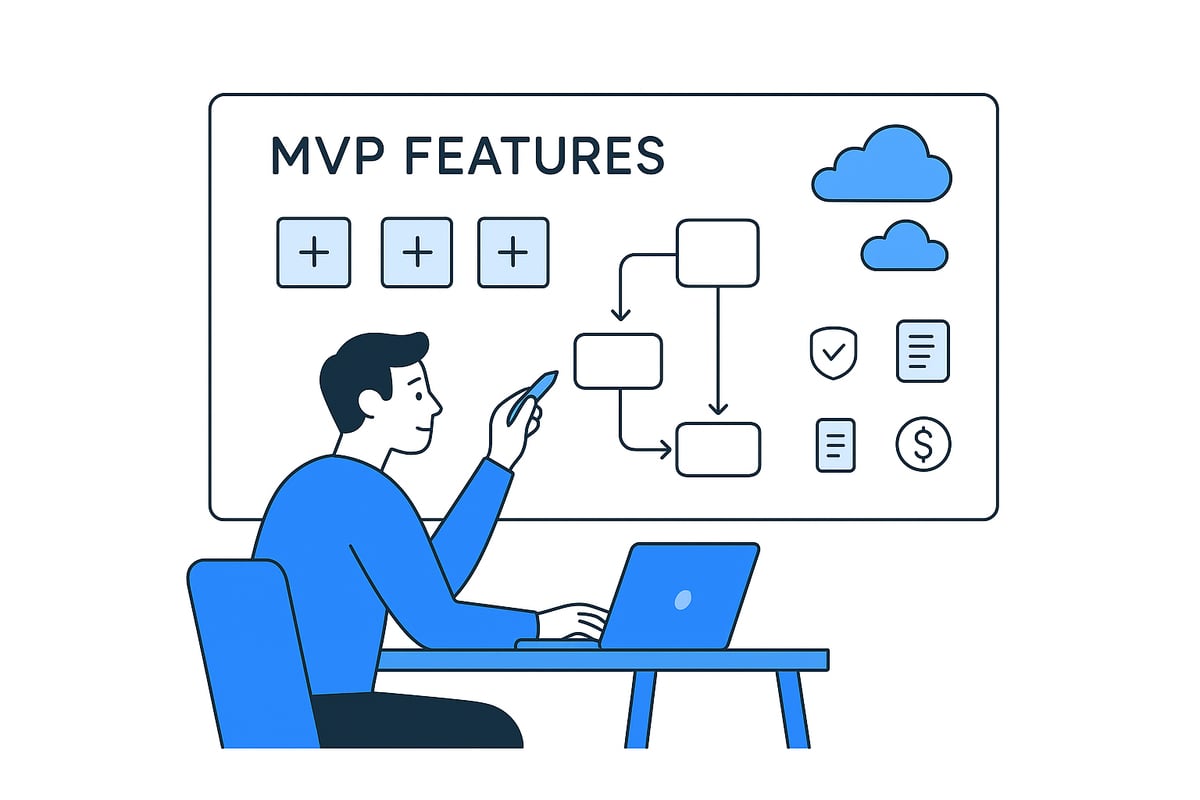
Define Core Features for Your MVP
Start by listing every feature you imagine for your mvp saas. Next, use frameworks like MoSCoW, RICE, or the Kano model to filter this list down to the essentials.
Focus only on the features that directly solve your users' primary pain point. For instance, a healthcare mvp saas should address document and client management before considering extras like CRM or time tracking. Overbuilding is a frequent reason why MVPs fail—keep your initial scope tight to validate demand quickly.
Map User Journeys & Outcomes
Understanding how users will interact with your mvp saas is crucial. Develop user personas that reflect your ideal customers, and map their workflows from first login to achieving their goals.
Concentrate on the "jobs to be done"—what is the main outcome your SaaS must deliver? For many mvp saas products, a seamless onboarding experience is critical, especially if your target market prefers self-service. Visualizing these journeys helps you spot friction points early.
Choose the Right Business Model for 2026
Selecting an effective business model sets the foundation for your mvp saas growth. Evaluate pricing strategies such as flat rate, tiered, freemium, usage-based, or value-based models.
Larger SaaS firms often succeed with value-based pricing, while startups may lean toward competitor-based or freemium models. Keep an eye on Everything-as-a-Service (EaaS) trends, which promote recurring revenue and data-driven expansion. Your model should reflect your target audience's needs and purchasing behavior.
Ensure Security & Compliance from Day One
Security is non-negotiable for any mvp saas, especially if you handle sensitive data. Adopt ISO/IEC 27001 best practices, including multi-factor authentication, encryption, and role-based access controls.
Plan for compliance requirements like GDPR or HIPAA from the start, as retrofitting security later can be costly and risky. Building trust early helps you stand out in regulated industries.
Plan for Scalability & Cost Efficiency
Your mvp saas must be ready to grow, but you do not need to engineer for millions of users on day one. Choose cloud providers such as AWS, Azure, or GCP for flexible scaling.
Avoid over-engineering—build for your first 10 to 100 users, then expand as demand increases. For a deeper dive into tech stack choices and agile methods, consult the SaaS MVP Development Guide, which outlines best practices for modern SaaS startups.
Set Realistic Budgets & Timelines
Budgeting is key for a successful mvp saas launch. Typical MVP development costs range from $25,000 to $60,000, depending on your team's location and expertise.
Consider outsourcing to reduce expenses, but vet your partners carefully. Set clear milestones and timelines to keep your project on track, and always plan for unexpected delays.
Differentiate Your SaaS MVP
To stand out, your mvp saas must offer something unique. Identify your product's value proposition—this could be a smoother user experience, faster onboarding, or AI-powered automation.
Analyze competitors to spot gaps and opportunities. Even small UX improvements can make a big impact in a crowded market.
Step 3: Build, Prototype & Gather User Feedback
Turning your vision into a working MVP SaaS starts with building a prototype that users can interact with. This phase is where ideas become tangible, real feedback emerges, and your product starts to take shape. Every decision here should focus on learning what delivers value and what needs improvement.

Develop a High-Fidelity Prototype
Begin by translating your MVP SaaS concept into a high-fidelity prototype using tools like Figma or Adobe XD. Focus on the core workflows and essential features that define your product's value. The prototype should closely mirror the intended user interface and experience, allowing stakeholders and early users to grasp your vision clearly.
A well-executed prototype builds trust and provides a realistic sense of what your SaaS will deliver. Prioritize clarity and usability. Even if the backend is minimal, a polished front-end can validate assumptions and spark meaningful conversations. This is your first chance to see your MVP SaaS in action and spot design gaps before development begins.
Conduct Early User Testing
Once your prototype is ready, bring in your target users for hands-on testing. Observe how they interact with your MVP Saaas, where they hesitate, and what excites them. Use a mix of interviews and analytics to gather both qualitative and quantitative data.
Key steps for effective testing:
- Ask users to perform key tasks without guidance
- Note confusion points or repeated questions
- Measure how quickly they understand the core value
Testing with real users helps you identify friction points early. The insights you collect here are critical for refining your MVP SaaS before you commit to code.
Iterate Rapidly Based on Insights
Take user feedback and turn it into actionable improvements. Focus on simplifying navigation, clarifying messaging, and fine-tuning core features of your MVP SaaS. Rapid iteration at this stage saves time and money compared to post-launch changes.
Adopt a mindset of continuous improvement:
- Adjust user flows based on observed behaviors
- Remove unnecessary steps
- Update prototypes quickly and retest
Iterative cycles drive your MVP SaaS closer to product-market fit. The faster you learn, the faster you can deliver value and stand out from the competition.
Establish a Feedback Loop
Building an ongoing feedback loop is essential for sustainable growth. Set up channels like Slack groups, email surveys, or dedicated forums where early adopters can share their thoughts on your MVP SaaS.
Effective feedback loops:
- Encourage honest, constructive feedback
- Respond to user suggestions promptly
- Track feature usage with simple analytics tools
Active engagement helps you avoid “broken feedback loops,” ensuring you adapt your MVP SaaS to real market needs. This approach fosters trust and builds a community around your product.
Address Security, Compliance, and Documentation
Security and compliance are non-negotiable, even for early-stage MVP SaaS products. Test basic security features like MFA and encryption in your prototype. Map out compliance requirements relevant to your industry, such as GDPR or HIPAA, and document any decisions or feedback related to these areas.
Maintaining clear documentation of user feedback, technical choices, and compliance workflows sets up your MVP SaaS for smoother scaling and future audits. Early diligence here prevents costly rework and builds credibility with users and investors.
Prepare for Agile Development
Transitioning from prototype to development requires the right engineering practices. Set up CI/CD pipelines, trunk-based development, and rapid code reviews to support fast iteration. Embrace agile methodologies to keep your MVP SaaS adaptable and responsive to user needs.
For founders interested in proven strategies, this systematic study on software engineering practices for MVPs provides valuable insights on how SaaS startups can optimize their build-measure-learn cycles and accelerate time to market.
By following these steps, your MVP SaaS will be primed for real-world testing, rapid learning, and a successful launch.
Step 4: Launch Your SaaS MVP: Go-to-Market & Early Traction Strategies
Launching your MVP SaaS is a pivotal moment that sets the tone for your software’s success. A strategic, well-executed launch not only attracts early adopters but also validates your core product assumptions in the real market.
Prepare a Lean, Impactful Launch
Before you announce your MVP SaaS to the world, finalize your product’s scope. Only include features that have been validated through user feedback and testing. Prioritize a polished user interface, as first impressions directly influence adoption rates.
Set up basic analytics to track user behavior from day one. Even at this early stage, understanding how users interact with your MVP SaaS helps identify friction points and guides future iterations.
Create a Go-to-Market Plan
A robust go-to-market plan is essential for capturing attention in the crowded SaaS landscape. Start by identifying your primary acquisition channels. Product Hunt, BetaList, LinkedIn, and niche industry forums are proven platforms for promoting your MVP SaaS to targeted audiences.
Build a pre-launch waitlist to nurture early adopters. Use email sequences to keep them engaged and informed about your launch timeline. A simple landing page can be a powerful tool for testing real demand and collecting leads. If you need practical resources, explore these Tools for SaaS landing page validation to optimize your MVP SaaS outreach and gather actionable insights.
Pricing & Monetization at Launch
Set transparent, compelling pricing that aligns with your MVP SaaS’s value proposition. Early bird pricing, freemium tiers, or limited-time discounts can incentivize sign-ups without overwhelming your users with choices.
Communicate your pricing clearly. The goal is to make it easy for early users to understand the benefits and take action. Remember, early traction and revenue are powerful signals for future growth and investment.
Customer Support & Community Building
Delivering excellent support at launch builds trust and keeps your MVP SaaS users engaged. Set up live chat, helpdesk, and onboarding guides to assist new customers. Proactive support reduces churn and turns users into advocates.
Foster a feedback-driven community through forums or Slack groups. Early adopters who feel heard are more likely to provide constructive feedback and promote your MVP SaaS within their networks.
Monitor Key Metrics & KPIs
Track essential metrics from the start. Focus on activation rates, user retention, churn, and feature usage. Real-time analytics help you spot bottlenecks and uncover growth opportunities for your MVP SaaS.
A simple metrics table can help you stay organized:
| Metric | Why It Matters |
|---|---|
| Activation | Measures onboarding success |
| Retention | Indicates user satisfaction |
| Churn | Reveals drop-off causes |
| Feature Usage | Guides future development |
Iterate quickly based on these insights to maximize early traction.
Address Security, Compliance, and Scaling
From the first users, monitor your MVP Saaas for security and compliance issues. Set up alerts for suspicious activity and ensure all data is protected. As you gain traction, prepare your cloud infrastructure for scaling, so your MVP SaaS can handle user spikes without interruption. For technical teams, reviewing Scalable SaaS Architecture can provide best practices for growth-ready infrastructure.
Early Investor & Partner Outreach
Once you achieve initial traction, leverage your MVP SaaS metrics to approach investors or strategic partners. Highlight user growth, engagement, and validated demand in your pitch. Early proof points from your launch can open doors to funding and valuable alliances.
A strong launch is more than a milestone—it is the foundation for your MVP SaaS’s long-term success. By focusing on user needs, feedback, and rapid iteration, you set your product on the path to scalable growth.
Step 5: Iterate, Scale & Prepare for Full Product Development
Scaling your mvp saas is not a one-time event but a continuous journey. As your user base grows, adapting quickly to feedback and evolving needs will set your product apart. This final step focuses on building a resilient foundation for sustainable growth and long-term success.
Analyze User Data & Feedback
Consistently collecting and analyzing user data is essential for mvp saas evolution. Review support tickets, analytics dashboards, and direct feedback channels to understand user behavior and recurring pain points.
Look for patterns in feature usage, onboarding drop-offs, and churn events. For example, heatmaps and funnel analysis can pinpoint where users struggle or disengage. This insight helps you prioritize what truly matters for your next development cycles.
Prioritize Feature Enhancements
With real-world data in hand, use frameworks like RICE or MoSCoW to evaluate feature requests and improvements. Focus on enhancements that will drive user retention and solve core workflows, rather than adding every requested function.
For vertical SaaS solutions, consider reviewing Vertical SaaS MVP validation steps to ensure your roadmap aligns with niche market needs. Always validate demand before committing significant resources to new features.
Strengthen Security & Compliance as You Scale
As your mvp saas attracts more users, security and compliance must scale accordingly. Implement advanced security protocols, such as regular penetration testing, automated vulnerability scans, and stricter access controls.
If you operate in regulated industries, prepare for audits and ongoing compliance reviews. Document all security policies and ensure your team stays updated on evolving standards like GDPR, HIPAA, or PCI DSS.
Optimize Infrastructure for Growth
Infrastructure optimization is crucial for supporting an expanding mvp saas user base. Monitor cloud resource utilization, automate scaling with managed services, and periodically review performance metrics.
Consider a table to track infrastructure priorities:
| Task | Tool/Approach | Frequency |
|---|---|---|
| Cost Monitoring | AWS Cost Explorer | Weekly |
| Performance Audit | New Relic | Monthly |
| Scaling Automation | Kubernetes | As needed |
This disciplined approach keeps costs predictable while ensuring seamless user experiences.
Expand Marketing & Sales Efforts
Use early traction data to refine marketing campaigns and identify the channels delivering the highest ROI for your mvp saas. Invest in content marketing, targeted ads, and strategic partnerships.
Gather and showcase user testimonials, leveraging them in outreach to new prospects. As momentum builds, consider expanding your sales team or onboarding affiliate partners to accelerate growth.
Prepare for Full Product Build-Out
Once your mvp saas demonstrates sustained engagement and clear market fit, begin planning full product development. Use validated learnings to expand your feature set, enhance integrations, and refine user experience.
Secure additional funding, whether through reinvested revenue or new investment rounds, to support this next phase. Maintain agility in your roadmap, allowing for rapid adjustments as new insights emerge.
Stay Ahead of 2026 SaaS Trends
The SaaS landscape will continue to evolve rapidly. Monitor emerging trends, such as AI-driven automation, new compliance requirements, and evolving customer expectations.
Regularly revisit your product vision and user research to keep your mvp saas relevant and competitive. Consistent innovation, backed by real user data, is your best defense against market shifts.