
The global SaaS market is on track to surpass all previous records, with innovation and competition accelerating as we approach 2026. This saas guide is your essential resource for navigating the evolving landscape, whether you're a founder, executive, or aspiring entrepreneur.
Inside, you'll discover the pillars of the SaaS business model, vital metrics for growth, proven operational strategies, and robust financial frameworks. We also spotlight the trends that will define the future of SaaS.
Gain actionable insights, leverage expert tactics, and take confident steps to future-proof your SaaS venture with this comprehensive handbook.
The SaaS Business Model: Fundamentals for 2026
The SaaS business model has become the backbone of digital transformation worldwide. As outlined in this saas guide, understanding the mechanics behind SaaS is essential for anyone aiming to thrive in 2026. Let’s break down the core pillars, compare SaaS with related models, and assess the advantages and challenges shaping the landscape today.
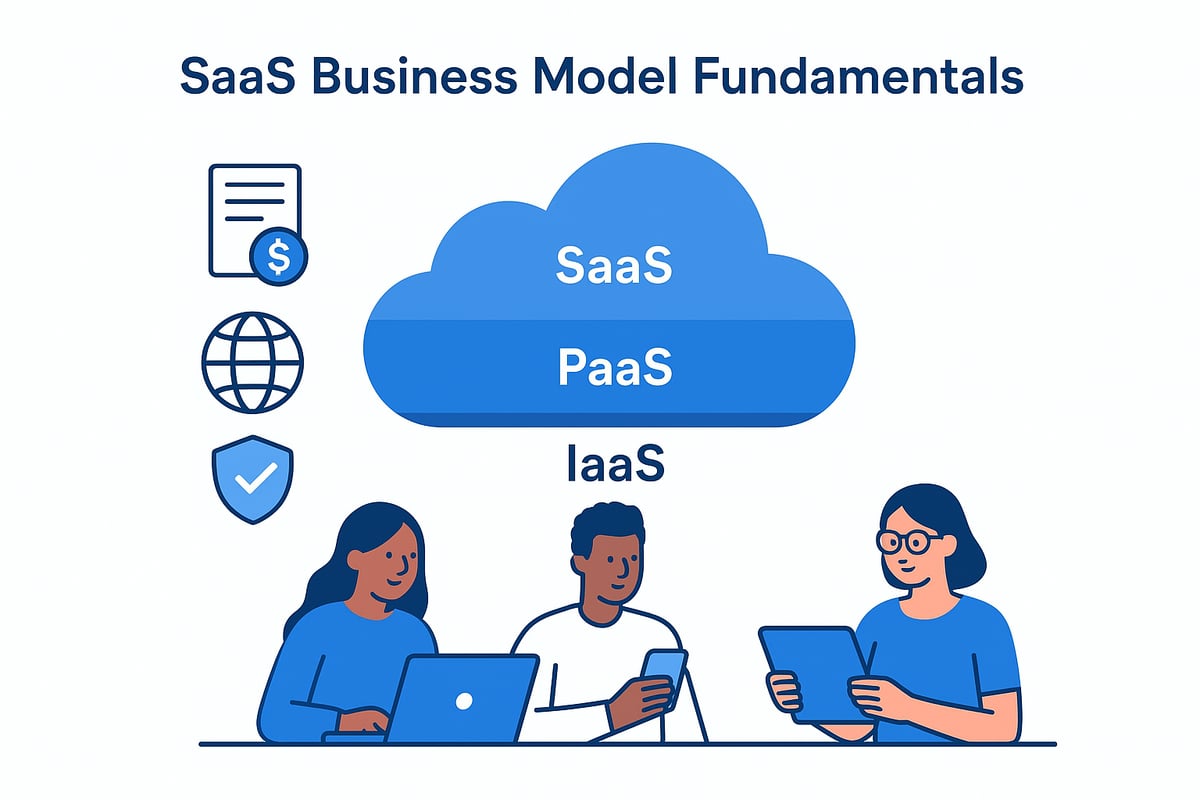
The Core Pillars of SaaS
At its heart, the saas guide emphasizes four foundational pillars that define SaaS in 2026. First, centralized ownership and cloud hosting mean that providers retain full control over their software, deploying it via leading platforms such as AWS, Azure, or Google Cloud. This approach ensures seamless updates, rapid scaling, and global availability.
Second, the subscription pricing model is a hallmark of SaaS. Businesses enjoy predictable, recurring revenue streams through flexible plans—ranging from monthly to annual, with options for tiered, usage-based, or per-user pricing. This structure appeals to both startups and enterprises, allowing for budget-friendly access and scalability.
Third, internet-based delivery empowers customers to access services from anywhere using just a web browser. This universal accessibility is key for remote teams and global audiences. Notable examples like G Suite, Dropbox, Slack, and Salesforce demonstrate the versatility and reach of modern SaaS solutions.
For a deeper dive into these foundational elements, explore the Modern SaaS business models resource, which complements this saas guide with practical frameworks and case studies.
SaaS vs. PaaS vs. IaaS: Understanding the Differences
A comprehensive saas guide must clarify the distinctions between SaaS, PaaS, and IaaS. Each offers a unique layer within the cloud service ecosystem, targeting different user needs.
| Model | Definition | Primary Users | Example |
|---|---|---|---|
| SaaS | Software delivered via the cloud, managed by provider | End-users/businesses | Slack, Salesforce |
| PaaS | Platform for building, testing, and deploying apps | Developers | AWS Elastic Beanstalk |
| IaaS | Cloud infrastructure resources (servers, storage) | IT teams | Google Compute Engine |
SaaS is designed for end-users who need ready-to-use applications. PaaS targets developers looking to build and deploy apps without managing infrastructure. IaaS provides the raw computing resources, ideal for businesses that want full control over their environments.
Understanding these differences helps you position your offering in the right market segment. This saas guide recommends evaluating your business goals and customer needs before selecting your approach.
Advantages of the SaaS Model
The saas guide highlights several compelling advantages of adopting the SaaS model. Scalability and accessibility stand out: businesses can serve unlimited users globally, with minimal setup required on the client side. Cloud infrastructure makes it easy to add resources as demand grows.
Automatic updates are another major benefit. Providers can roll out new features and security patches instantly, ensuring customers always have the latest version. This reduces IT overhead for clients and strengthens security.
Customization and CRM integration are increasingly important. Flexible pricing plans and personalized user experiences allow SaaS companies to cater to diverse audiences, from small startups to large enterprises. Predictable, pay-as-you-use pricing simplifies financial forecasting, making SaaS an attractive choice for CFOs and budget-conscious teams.
Challenges in SaaS
While the saas guide champions the benefits, it also addresses the notable challenges facing SaaS businesses. Cybersecurity risks are at the forefront, as sensitive data is stored on third-party servers. Companies must comply with strict regulations and invest in robust security measures to build customer trust.
Long sales cycles and high customer acquisition costs can strain early-stage SaaS startups. Convincing organizations to switch platforms or adopt new tools often requires significant education and resources. Additionally, the SaaS market is fiercely competitive. Low barriers to entry have led to market saturation, making differentiation and ongoing innovation essential.
Despite these hurdles, the saas guide demonstrates that with a clear strategy and an understanding of these fundamentals, SaaS businesses can position themselves for sustainable success in 2026.
Key Metrics and Financial Management in SaaS
Understanding the financial engine behind your SaaS business is critical for long-term success. In this saas guide, we break down essential metrics, accounting principles, and compliance requirements that every founder should master. Accurate financial management is the backbone of sustainable growth and investor confidence.
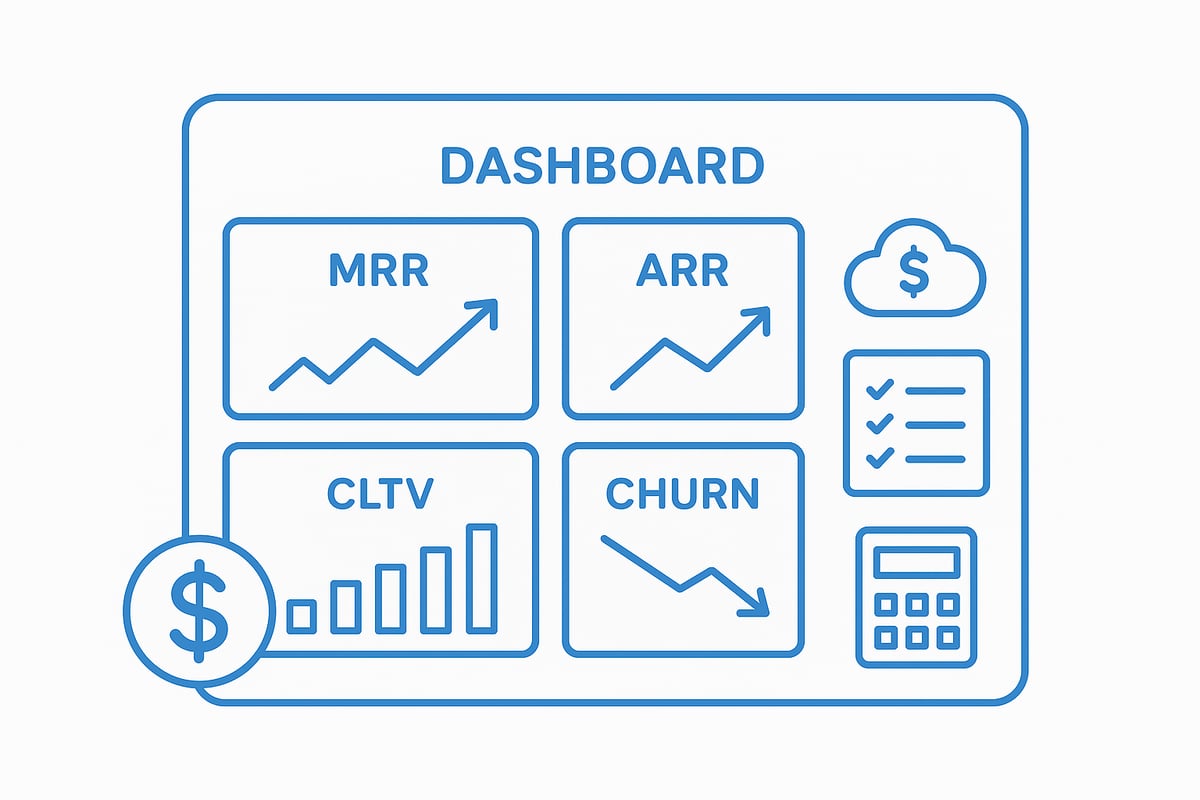
Essential SaaS Metrics for Growth
Key metrics are the compass for every SaaS business. They inform strategic decisions, reveal growth opportunities, and highlight risks. The core metrics in this saas guide include:
| Metric | Definition | Importance |
|---|---|---|
| MRR | Monthly Recurring Revenue | Tracks predictable income |
| ARR | Annual Recurring Revenue | Measures long-term revenue health |
| CLTV | Customer Lifetime Value | Guides retention and marketing spend |
| Churn Rate | % of customers lost per period | Identifies attrition and retention issues |
| CAC | Customer Acquisition Cost | Assesses marketing efficiency |
| Gross Margin | Revenue minus cost of goods sold | Indicates profitability and scalability |
For example, MRR is calculated as:
MRR = Total monthly active customers * Average revenue per user (ARPU)
CLTV helps you determine how much you can invest in acquiring customers:
CLTV = ARPU * Gross Margin % * Average Customer Lifespan (months)
Monitoring these metrics allows teams to spot trends early and adapt. For a deeper dive into industry benchmarks and adoption rates, review SaaS Industry Statistics and Adoption Rates.
SaaS Accounting Principles
Sound accounting is the foundation of reliable reporting in this saas guide. SaaS businesses typically choose between cash-basis and accrual accounting:
- Cash-basis: Revenue and expenses recorded when cash changes hands. Simple, but less accurate for SaaS.
- Accrual accounting: Revenue and expenses recorded when earned or incurred, regardless of payment timing. This matches revenue to service delivery, providing a clearer picture.
The IRS often requires accrual accounting for SaaS companies due to recurring, prepaid, or deferred revenue. Accurate bookkeeping matters for tax compliance and investor trust. It also helps manage one-time and recurring payments, upgrades, and downgrades.
A well-structured accounting process makes audits smoother and enables precise forecasting. In the saas guide, we recommend founders regularly review their financial statements for accuracy and transparency.
Revenue Recognition & GAAP Compliance
Revenue recognition is a key focus for SaaS companies and a core component of this saas guide. U.S. GAAP, specifically ASC 606, mandates that revenue is recognized as services are delivered rather than when cash is received.
Key terms include:
- Bookings: Total value of signed contracts.
- Billings: Invoices sent to customers.
- Revenue: Recognized as the service is provided.
Deferred revenue (payments received before delivery) appears as a liability on the balance sheet. Accrued revenue (services delivered before payment) is an asset. These concepts affect income statements, balance sheets, and cash flow statements.
Clear revenue recognition policies protect your business during audits and when raising capital. GAAP compliance also builds credibility with stakeholders.
Real-World Example
Let’s consider Chargebee’s approach. Chargebee, a leading SaaS billing platform, illustrates the difference between bookings, billings, and revenue in practice. When a customer signs up for an annual plan, the full amount is booked and billed upfront. However, revenue is recognized monthly as the service is delivered.
This distinction ensures financial statements reflect the true health of the business. It also enables SaaS founders to plan reinvestment and growth strategies confidently. Following the principles outlined in this saas guide, founders can avoid common pitfalls and maintain investor trust.
Operational Strategies for SaaS Success
Operational excellence defines the difference between SaaS leaders and those that lag behind. The right strategies can help your saas guide achieve both rapid growth and long-term sustainability. Let us explore the key operational pillars every founder should master.
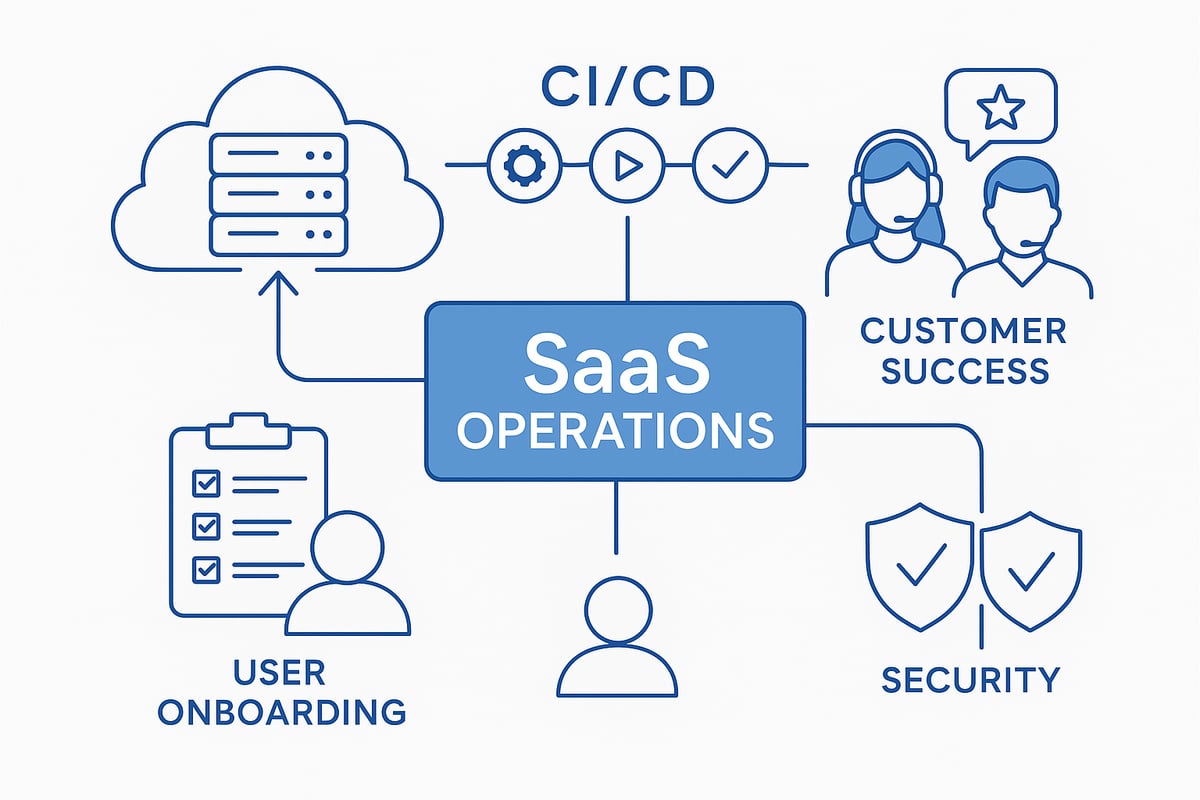
Building and Scaling Your SaaS Product
A modern saas guide begins with a robust technical foundation. Cloud-native architecture, using providers like AWS or Azure, ensures reliability and cost efficiency. Microservices allow for modularity, letting teams deploy updates quickly without impacting the entire platform.
Continuous integration and deployment (CI/CD) pipelines are crucial. They automate testing and deployment, shrinking release cycles and minimizing bugs. Consider this sample CI/CD workflow:
stages:
  - test
  - build
  - deploy
Balancing customization with scalability is vital. Offer flexible configurations for enterprise clients while maintaining a core product that can scale efficiently. Avoid feature bloat by prioritizing customer feedback. Engage users through surveys and analytics to guide your product roadmap.
For step-by-step advice on scaling, the SaaS product scaling guide provides actionable frameworks and best practices. Leverage these resources to ensure your saas guide evolves with market demands.
Customer Acquisition and Retention
Acquiring and retaining customers is the lifeblood of any saas guide. Multi-channel marketing, including paid media, SEO, and content, establishes brand presence and drives leads. Product-led growth (PLG) strategies use the product itself to attract and convert users. Features like free trials or interactive demos lower barriers and increase engagement.
Choosing between sales-led and self-serve models depends on your target market. Enterprise clients may require a dedicated sales team, while SMBs often prefer self-service signups. Some businesses blend both approaches for maximum reach.
Effective onboarding is essential. Streamline the initial user experience and provide clear documentation to reduce time-to-value. Use in-app guidance and tutorials to boost adoption rates. A well-executed onboarding process lays the foundation for customer loyalty and future upsells.
Support and Customer Success
Outstanding support is a cornerstone of the saas guide. Proactive support, such as real-time chat and AI-driven ticketing, helps resolve issues before they escalate. Customer success teams monitor health scores, reach out to at-risk users, and identify opportunities for expansion revenue.
Consider this table summarizing support strategies:
| Strategy | Benefit | Example Tool |
|---|---|---|
| Live Chat | Immediate resolution | Intercom |
| AI Automation | 24/7 support, cost saving | Zendesk AI |
| Success Outreach | Reduced churn | Gainsight |
Automation and AI are transforming support workflows. Bots handle routine queries, freeing up human agents for complex cases. This increases efficiency and elevates customer satisfaction, both crucial for recurring revenue.
Security and Compliance
Trust is non-negotiable in the saas guide. Data protection policies must align with regulations like GDPR and CCPA. Encrypt data at rest and in transit, and implement regular security audits. Transparent privacy policies build credibility, especially with enterprise clients.
Compliance is more than ticking boxes. It involves ongoing monitoring, documentation, and incident response planning. Certifications such as SOC 2 or ISO 27001 demonstrate your commitment to best practices. Train your team regularly to stay ahead of evolving threats.
Leading SaaS companies, like Salesforce and Slack, prioritize customer success and operational excellence. Their playbooks emphasize proactive support, robust security, and a relentless focus on user needs. Emulating these strategies will position your saas guide for industry leadership.
Pricing, Monetization, and Market Expansion
Choosing the right pricing, monetization, and market expansion strategies is crucial for any company aiming to thrive with the help of a strong saas guide. As customer needs change and competition intensifies, aligning your pricing and growth tactics with industry best practices becomes a significant differentiator.
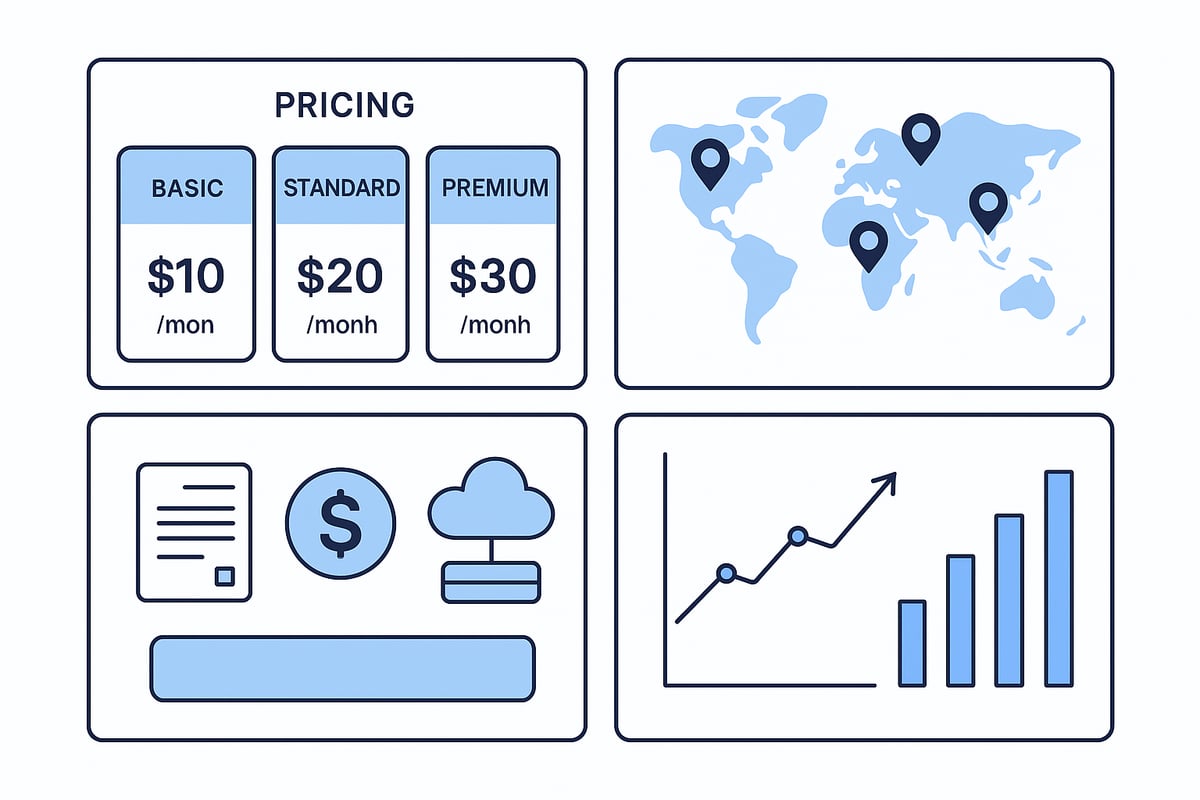
Modern SaaS Pricing Strategies
A successful saas guide emphasizes that pricing models are central to value delivery and revenue growth. The most common SaaS pricing strategies include:
- Tiered Pricing: Multiple plans based on features or usage, letting customers choose what fits best.
- Usage-Based Pricing: Charges based on actual consumption, popular among API-driven or infrastructure SaaS.
- Hybrid Models: Combine tiered and usage-based approaches for flexibility.
Here’s a quick comparison:
| Model | Pros | Cons | Example |
|---|---|---|---|
| Tiered | Easy upsell, clear segmentation | Can confuse, risk of wrong fit | Slack |
| Usage-Based | Aligns cost to value, scalable | Harder to predict revenue | AWS Lambda |
| Per-User | Simple, familiar to buyers | May limit team adoption | Salesforce |
| Hybrid | Balances flexibility and clarity | Complex to communicate | HubSpot |
Modern SaaS businesses use A/B testing to refine pricing, ensuring the chosen model resonates with each segment. Value-based pricing, which sets price according to customer-perceived value, is gaining traction in every saas guide as it maximizes willingness to pay while supporting customer satisfaction.
Monetization Tactics
A comprehensive saas guide highlights the importance of monetization beyond the initial sale. The freemium model attracts users with basic features at no cost, while a free trial offers full access for a limited time. Both aim to convert users to paid plans, but success depends on your product’s complexity and user expectations.
Expansion revenue is another key pillar. Upselling higher-tier plans, cross-selling complementary products, and offering add-ons create new revenue streams from existing customers. Streamlining billing and payment processes through user-friendly interfaces, transparent invoices, and flexible payment methods further reduces churn and boosts satisfaction.
To optimize these tactics, the saas guide recommends monitoring metrics like conversion rates, average revenue per account, and time-to-upgrade. This data-driven approach helps refine offers and messaging, ensuring sustainable and scalable growth.
Global Expansion and Localization
Scaling internationally is a natural next step outlined in any robust saas guide. Adapting your solution for global markets involves more than translating interfaces. You must localize currencies, payment gateways, and tax compliance to match each region’s regulatory landscape.
Effective market expansion also means investing in multilingual support and region-specific onboarding. SaaS leaders like Dropbox and HubSpot have shown how tailored infrastructure and responsive customer service fuel adoption worldwide.
According to Global SaaS Market Growth Projections, international SaaS revenues are set to surge as cloud adoption accelerates and businesses seek flexible, scalable solutions. Staying compliant and culturally relevant is essential for capturing this growth.
By following the strategies in this saas guide, founders and teams position themselves to capture new markets, increase lifetime value, and future-proof their business for 2026 and beyond.
Future Trends and Innovations in SaaS
The next wave of SaaS innovation is redefining how businesses operate and deliver value. As we look toward 2026, this saas guide explores pivotal trends that will shape the industry, from artificial intelligence to ethical responsibility. Staying ahead means understanding these developments and translating them into actionable strategies for your SaaS business.
AI and Automation in SaaS
Artificial intelligence is at the core of SaaS transformation, powering smarter workflows, predictive analytics, and hyper-personalized experiences. By 2026, over 70% of SaaS platforms are expected to integrate AI-driven features, automating routine tasks and boosting operational efficiency. AI enables real-time data analysis, adaptive user interfaces, and intelligent support bots.
Automation is not just about speed—it reduces human error, lowers costs, and scales customer support. For a deeper look at AI’s rapid commoditization and its role in market expansion, review AI Integration in SaaS Platforms. Every forward-thinking saas guide must address how AI will continue to shape competitive advantage.
Vertical SaaS and Industry Specialization
Vertical SaaS solutions are gaining momentum as providers focus on industry-specific needs. By tailoring features for sectors like healthcare, legal, or education, SaaS companies deliver deeper value and address unique compliance requirements. This specialization builds customer trust and accelerates time-to-value.
Domain expertise becomes a key differentiator, helping vertical SaaS platforms stand out in crowded markets. If you are considering this strategy, explore Vertical SaaS validation steps for proven methods to test your niche. Any effective saas guide will highlight the power of targeting underserved industries.
Low-Code/No-Code Platforms
Low-code and no-code development tools are democratizing SaaS creation, empowering non-technical users to build and customize applications. These platforms accelerate innovation by reducing reliance on engineering teams and enabling rapid prototyping.
Organizations can now adapt workflows, integrate APIs, and launch MVPs with minimal coding knowledge. This trend lowers barriers to entry and fosters a culture of experimentation. In the modern saas guide, low-code solutions are essential for agility and customer-driven growth.
Security and Privacy Innovations
Security and privacy remain top priorities as SaaS adoption expands. Advanced cybersecurity measures, such as zero-trust architecture and end-to-end encryption, protect sensitive data from evolving threats. Regulatory compliance (GDPR, CCPA) is now integral to product design, especially for enterprise customers.
Transparency in security practices builds trust and sets leaders apart. SaaS companies are also embedding privacy-first principles, ensuring user data is handled responsibly. A comprehensive saas guide must emphasize proactive compliance and robust protection strategies.
Sustainability and Ethical SaaS
Sustainability is no longer optional in the SaaS landscape. Companies are adopting green hosting, optimizing energy use, and measuring their environmental impact. Ethical SaaS also means responsible data usage and supporting social good through technology.
Investors and customers increasingly demand ESG accountability. By prioritizing sustainability, SaaS businesses not only reduce risk but also gain a competitive edge. As outlined in this saas guide, ethical leadership is a core driver of long-term success in 2026.
SaaS Validation: The Critical First Step for Founders
Before building your product, every founder should recognize that validation is the single most important step in any saas guide. The majority of SaaS startups fail, not because of poor execution, but due to a lack of real market demand or an unclear product-market fit. Skipping validation exposes founders to unnecessary risks and wasted resources.
A robust saas guide always emphasizes early and thorough validation. By testing your assumptions before development, you reduce risk, save time, and position your SaaS for sustainable growth. SaaS Validation offers a suite of resources, from step-by-step guides to expert insights, to help founders navigate this crucial phase.
Effective SaaS validation strategies include:
- Conducting in-depth customer interviews to uncover genuine pain points.
- Launching a minimum viable product (MVP) to collect real user feedback.
- Performing detailed competitor analysis to identify gaps and differentiation.
- Gathering insights from early adopters to refine your offering.
For practical guidance tailored to your strengths as a founder, explore these SaaS validation strategies for founders. These tools are designed to help you make informed decisions and avoid common pitfalls in the early stages.
The saas guide is not just about building and scaling. It is about starting strong, with confidence in your product’s potential. Leverage the SaaS Validation community and resources to transform your idea into a successful, market-ready solution.