AI SaaS products are redefining how companies operate, innovate, and compete across every industry. The surge of intelligent software has fueled dramatic shifts in workflows and business models, with real-world organizations already experiencing increased efficiency and productivity. Imagine gaining a decisive edge as your teams automate complex processes, extract actionable insights, and deliver exceptional customer experiences. In this article, discover seven essential AI SaaS products that are revolutionizing business in 2026. From automation and analytics to customer engagement and beyond, these tools are set to shape the future of work.
7 Essential AI SaaS Products Transforming Business in 2026
Artificial intelligence is fundamentally changing the way organizations operate, collaborate, and grow. The rapid evolution of ai saas products is reshaping business processes across industries, from marketing to customer support. In this section, we explore the top ai saas products that are driving efficiency, productivity, and innovation in 2026.
To ensure a comprehensive perspective, our selection criteria include innovation, adoption rates, business impact, and unique AI capabilities. We’ve prioritized diversity, featuring ai saas products that address a wide range of business functions, from automation and analytics to customer experience. For a deeper understanding of how these solutions are redefining the landscape, visit our guide on AI-powered SaaS solutions.
Below is a quick comparison of the featured ai saas products:
| Product | Core Function | Starting Price | Best For |
|---|---|---|---|
| Jasper AI | Content Creation | $49/month | Marketing, SMBs |
| UiPath | Process Automation | Varies | Enterprises, Ops |
| Gong | Sales Analytics | Custom | Sales, RevOps |
| Synthesia | Video Generation | $30/month | L&D, HR, Marketers |
| DataRobot | AutoML/Analytics | Custom | Analysts, Leadership |
| Zendesk AI | Support Automation | $50/agent/mo | Support, E-commerce |
| HubSpot AI | CRM & Marketing | $800/month | SMBs, Agencies |
Let’s dive into each solution to see how these ai saas products are transforming modern business.
Jasper AI
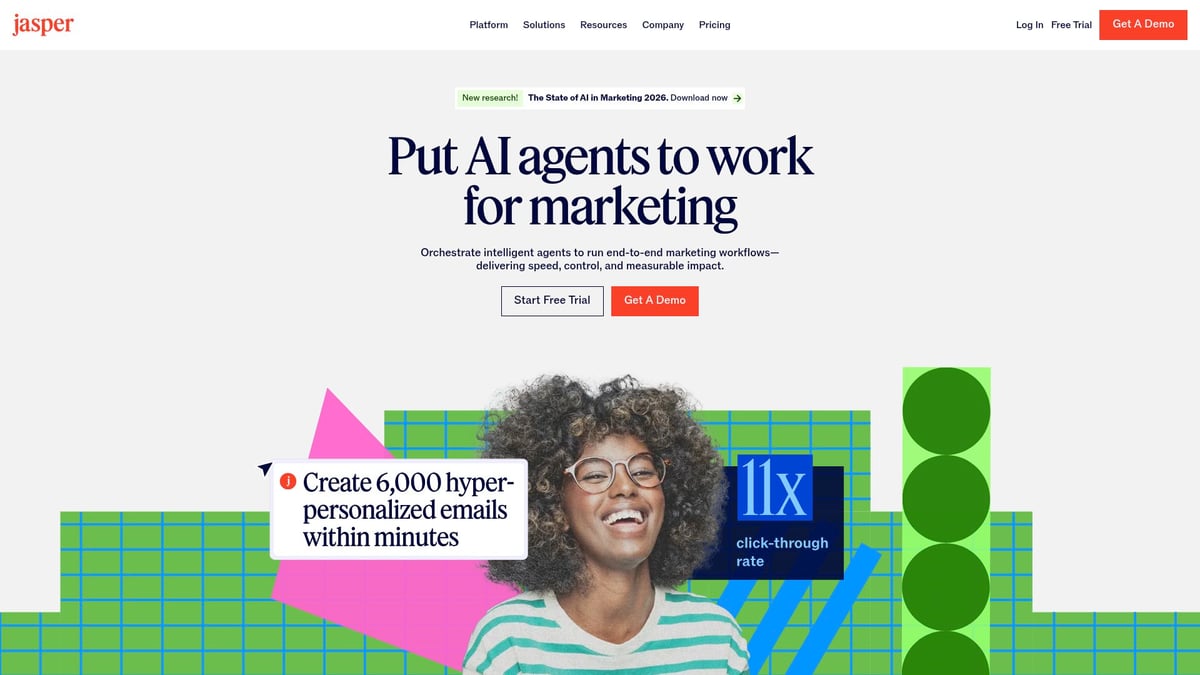
Jasper AI leads the charge among ai saas products for content creation. This platform is subscription-based, with plans starting at $49 per month. It leverages advanced language models to generate marketing copy, blog posts, sales emails, and even internal communications.
Core features include:
- AI-powered content creation tailored for multiple use cases
- Customizable tone and brand voice for consistency
- Robust integrations with marketing and publishing tools
The primary benefits of Jasper AI are rapid content production, up to 80% faster than traditional methods, and increased engagement rates through brand consistency. Marketing teams, content creators, agencies, and SMBs benefit the most from this solution.
Pros:
- User-friendly interface
- Quick, high-quality output
- Broad integrations
Cons:
- Occasional factual inaccuracies
- Some advanced features locked behind higher tiers
A B2B SaaS company recently used Jasper AI to double its blog output and increase lead generation. According to a 2025 survey, 70% of marketing leaders consider ai saas products like Jasper AI essential for their strategy.
UiPath
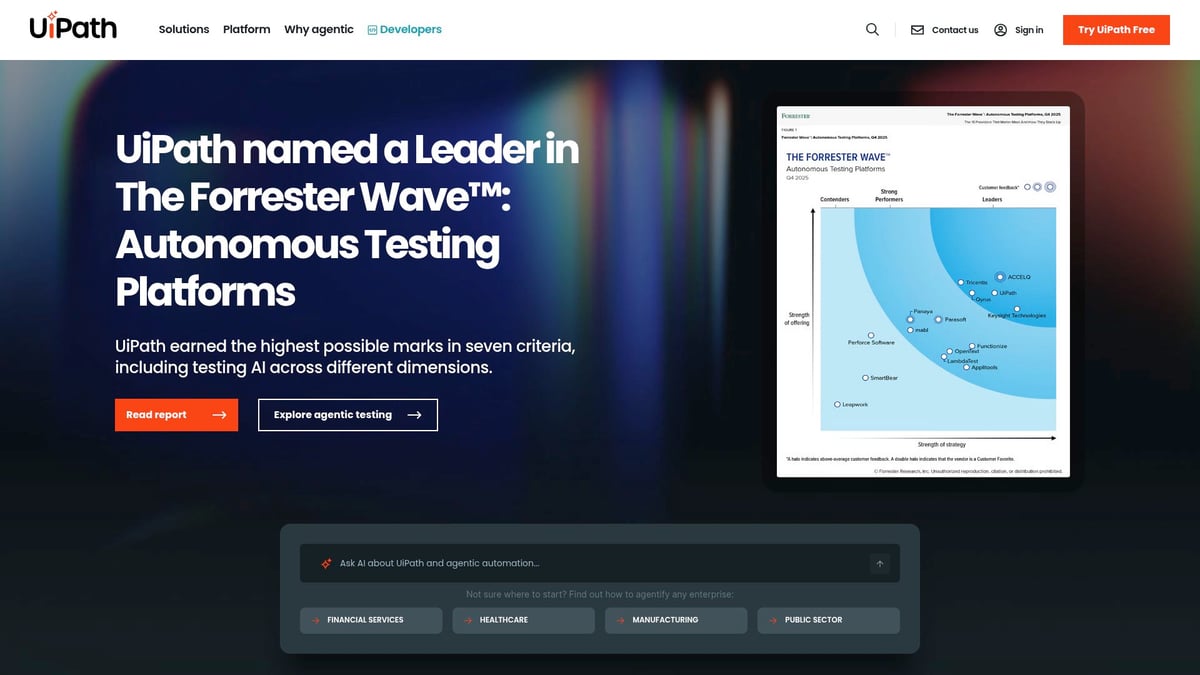
UiPath is a standout in the field of ai saas products focused on automation. Its pricing is tiered for SMBs and enterprises, with a free community edition for smaller teams. UiPath offers end-to-end robotic process automation, AI-powered document understanding, workflow analytics, and seamless integration with legacy systems.
Key features:
- Scalable automation for repetitive tasks
- AI-driven document processing
- Workflow analytics for optimization
Benefits include greater operational efficiency and a significant reduction in human error. Enterprises, finance, HR, and operations teams are the main target audiences.
Pros:
- Highly scalable for large organizations
- Active community support
- Advanced security features
Cons:
- Customization can involve a learning curve
- Resource demands may be high for smaller firms
A leading financial services firm cut their processing times by 60% after deploying UiPath bots. Gartner reported a 30% year-over-year growth in RPA adoption among ai saas products in 2025.
Gong
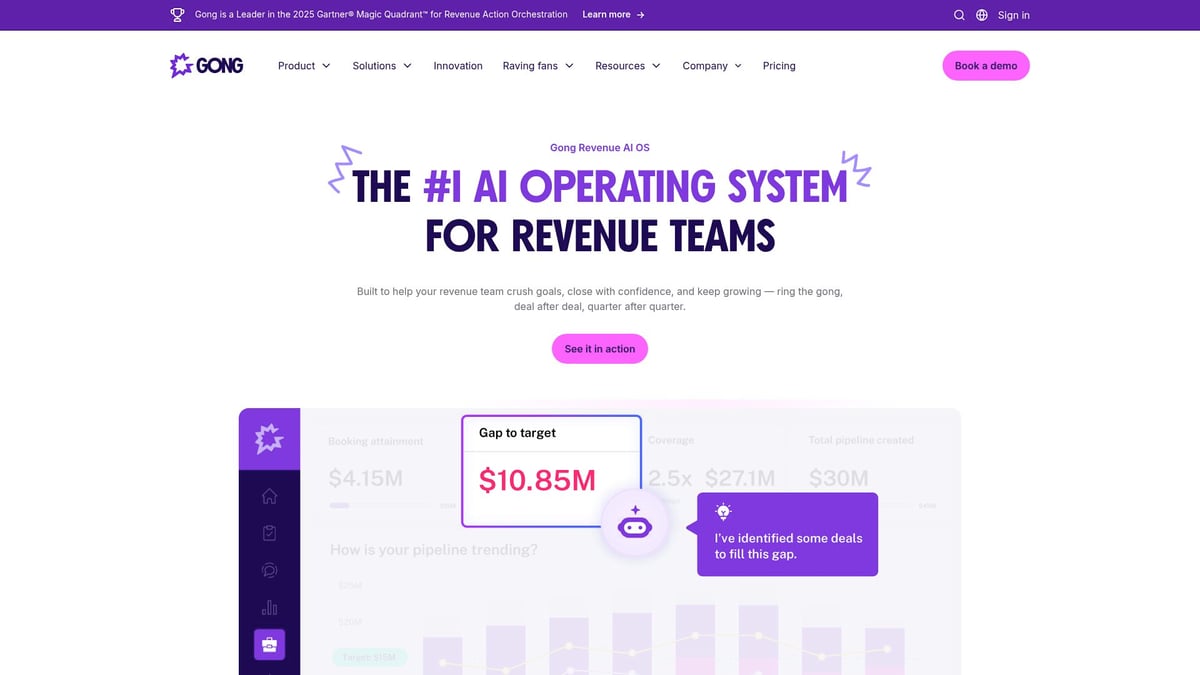
Gong is a leader among ai saas products for sales conversation analytics. Pricing is customized based on team size and required features. Its core strengths include AI-driven analysis of sales calls, deal forecasting, real-time coaching, and CRM integration.
Notable features:
- Deep analytics of customer interactions
- Automated deal forecasting
- Real-time coaching for sales reps
Gong helps improve sales performance and win rates by turning conversations into actionable insights. It is tailored for sales teams, revenue operations, and customer success managers.
Pros:
- Actionable recommendations based on data
- Seamless CRM integrations
- Comprehensive analytics dashboard
Cons:
- Requires organizational buy-in for full adoption
- Setup process can be time-consuming
A SaaS company using Gong improved pipeline accuracy by 35%. In 2025, firms leveraging AI analytics through ai saas products like Gong reported 25% higher sales productivity.
Synthesia
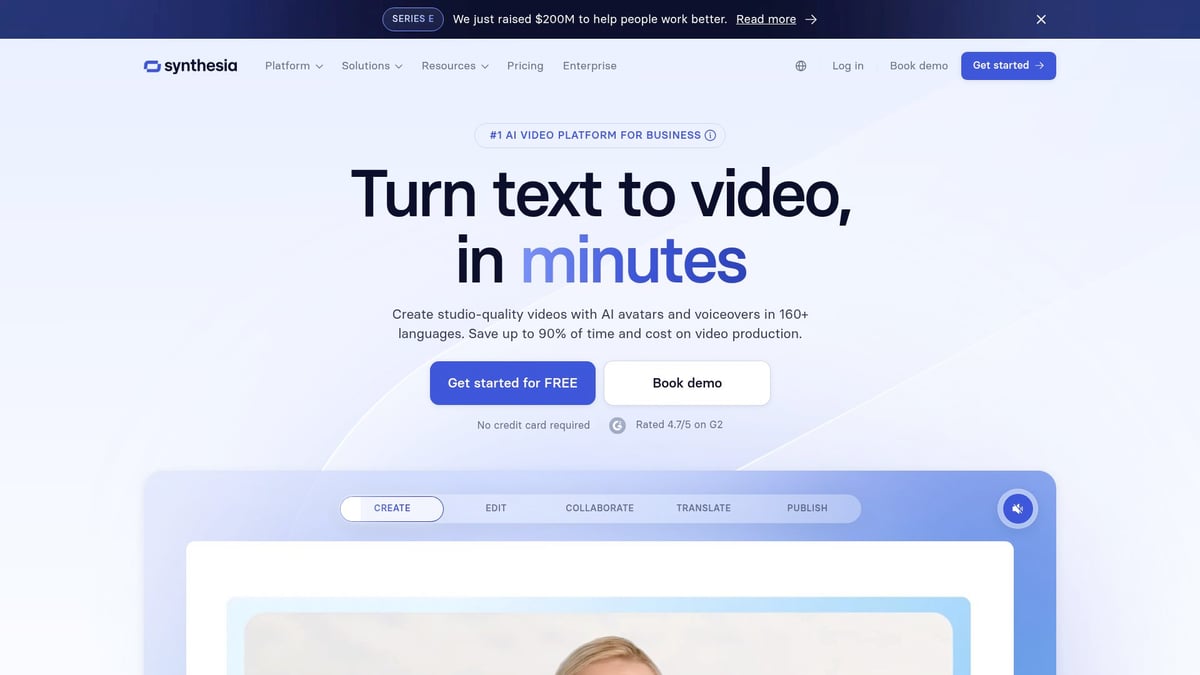
Synthesia is a game-changer in the ai saas products category for video creation. Plans start at $30 per month, with options for enterprise needs. The platform enables AI video generation, multi-language support, customizable avatars, and script-to-video automation.
Major features:
- Quick video creation at scale
- Multi-language and localization tools
- Customizable avatars for diverse audiences
The benefits are significant: companies can reduce video production costs and personalize training or marketing materials. L&D teams, marketers, HR specialists, and global enterprises are the main users.
Pros:
- Fast production turnaround
- Supports a wide range of languages
- Intuitive platform design
Cons:
- Limited avatar choices at lower tiers
- Some visuals may appear less natural
A global retailer reduced training costs by 50% using Synthesia. Video-based learning saw a 40% increase in adoption in corporate environments in 2026, highlighting the impact of ai saas products like Synthesia.
DataRobot
Among ai saas products for data science, DataRobot stands out for its automated machine learning capabilities. Pricing is custom for enterprises, with a free trial available. DataRobot empowers non-technical users to build and deploy AI models, offering features such as predictive analytics, data prep, and model deployment.
Key features:
- No-code/low-code AI model building
- Automated predictive analytics
- Extensive integrations with enterprise data sources
Benefits include democratizing advanced analytics and accelerating decision-making. Data analysts, business intelligence teams, and enterprise leadership are the main beneficiaries.
Pros:
- User-friendly interface for all skill levels
- Robust integration ecosystem
- Comprehensive support and resources
Cons:
- Higher price point for small businesses
- Requires quality data for optimal results
A healthcare provider used DataRobot to predict patient readmissions, improving outcomes while saving time. Forrester found AutoML platforms like DataRobot cut model development time by 70% in 2025, underscoring the value of ai saas products for analytics.
Zendesk AI
Zendesk AI is a leading customer support solution among ai saas products. AI add-ons start at $50 per agent per month, with enterprise bundles available. Its core features include AI-powered automation, sentiment analysis, chatbot integration, and intelligent ticket routing.
Key features:
- Automated customer support workflows
- Sentiment and intent analysis
- Smart ticket assignment
Benefits are clear: reduced response times, increased customer satisfaction, and scalable support. Customer support teams, e-commerce, and SaaS platforms are the primary users.
Pros:
- Seamless integration with Zendesk suite
- Powerful real-time analytics
- Easy to set up and deploy
Cons:
- Advanced features require enterprise plans
- Niche industries may need customizations
An e-commerce brand improved first-response rates by 40% with Zendesk AI. In 2026, AI-driven support through ai saas products achieved 55% higher CSAT scores.
HubSpot AI
HubSpot AI is a unified platform among ai saas products, powering CRM, marketing automation, and sales processes. AI features are included in Professional and Enterprise plans, starting at $800 per month. Core features encompass AI-powered CRM, predictive lead scoring, automated campaigns, and content optimization.
Key features:
- Predictive lead scoring
- Automated marketing and sales workflows
- Content optimization using AI insights
HubSpot AI streamlines workflows and enhances customer insights for SMBs, marketing teams, sales ops, and agencies.
Pros:
- Unified platform with strong ecosystem
- Actionable insights from embedded AI
- Robust integration options
Cons:
- Entry-level plans lack advanced AI
- Can be costly for small teams
A SaaS startup increased lead conversion rates by 25% using HubSpot AI. In 2025, CRM platforms with embedded ai saas products enabled a sales cycle that was three times faster.
How to Evaluate and Choose the Right AI SaaS Product for Your Business
Selecting the best AI SaaS products for your business is a critical decision that can shape your company's growth and efficiency. With so many options on the market, a strategic approach will help you avoid costly mistakes and ensure the right fit for your unique needs.
1. Define Your Needs and Pain Points
Begin by mapping out your current workflows and identifying where AI SaaS products can deliver the most value. Are you aiming to automate repetitive tasks, enhance analytics, or improve customer engagement? Pinpointing your business pain points will focus your search and help you prioritize features that matter most.
2. Assess Integration Requirements
Evaluate how potential AI SaaS products will fit into your existing tech stack. Consider compatibility with your CRM, ERP, or marketing automation tools. Seamless integration reduces disruption and maximizes efficiency across your operations.
3. Evaluate Pricing Models and ROI
Take a close look at both direct and indirect costs. Subscription fees, onboarding expenses, and training investments all influence the total cost of ownership. Calculate expected ROI by estimating time savings, productivity gains, or revenue improvements tied to each solution.
| Evaluation Factor | Questions to Ask | Why It Matters |
|---|---|---|
| Business Needs | What are our top pain points? | Ensures product relevance |
| Integration | Does it work with existing systems? | Prevents workflow silos |
| Pricing & ROI | What is the total cost, and what is the expected ROI? | Supports budget decisions |
| Scalability & Customization | Can it grow with us, and is it customizable? | Future-proofs investment |
| Security & Compliance | Does it meet our security standards? | Protects data and reputation |
4. Prioritize Scalability and Customization
Choose AI SaaS products that can scale alongside your business. Look for platforms that allow customization, so you can tailor workflows, dashboards, and automations as your needs evolve. This flexibility is essential for long-term success.
5. Review Security, Compliance, and Data Privacy
Security is non-negotiable, especially if you operate in regulated industries. Confirm that vendors adhere to industry standards and offer robust data privacy controls. Compliance features can be a deciding factor for many organizations.
6. Examine Support and Community Resources
Strong customer support, clear onboarding materials, and an active user community can dramatically ease implementation. Read reviews and case studies to gauge the vendor's responsiveness and engagement.
7. Compare Reviews, Case Studies, and Analyst Reports
Third-party analysis provides an unbiased look at how AI SaaS products perform in real-world scenarios. AI in SaaS industry overview offers a deeper understanding of how artificial intelligence is transforming the SaaS landscape, which is valuable when evaluating potential solutions.
8. Leverage Free Trials and Demos
Most AI SaaS products offer free trials or interactive demos. Use these opportunities to test core features, evaluate user experience, and validate vendor claims before committing.
9. Make Data-Driven Decisions
Refer to industry statistics and adoption trends to benchmark your choices. For example, AI adoption in SaaS applications provides insights into current integration rates and business impacts, helping you set realistic expectations.
By following these steps, you can confidently select AI SaaS products that align with your goals, enhance productivity, and future-proof your business. Remember, a deliberate and informed approach will set you up for long-term success.
The Future of AI SaaS: Trends to Watch in 2026 and Beyond
The landscape for ai saas products is evolving rapidly, shaping how businesses operate and innovate. As we look toward 2026 and beyond, organizations should prepare for a wave of transformative advancements that will redefine the competitive landscape. Understanding these trends is crucial for any business seeking to harness the full power of ai saas products.
Key Trends Shaping the Future of AI SaaS Products
| Trend | Description |
|---|---|
| Hyper-personalization | AI tailors insights and actions to each business and user, boosting engagement and outcomes. |
| Vertical-specific solutions | Industry-focused ai saas products address unique needs in fields like healthcare and legal. |
| Autonomous decision-making | AI shifts from supporting to automating business decisions, reducing human workload. |
| Seamless integrations | Enhanced interoperability with APIs and no-code tools simplifies tech stack management. |
| Responsible AI | Emphasis on transparency, ethics, and compliance to build trust and meet regulations. |
| Democratization of AI | User-friendly tools empower non-technical staff to leverage advanced analytics and automation. |
| AI-as-a-collaborator | AI becomes an active partner in daily workflows, driving efficiency and innovation. |
The boundaries of what ai saas products can achieve are expanding, driven by advances in automation, analytics, and cloud architecture. For example, the rise of Outcome as Agentic Solution (OaAS) is transforming SaaS into a results-driven model, where AI systems deliver business outcomes directly.
As these changes accelerate, developers and SaaS companies are reimagining their platforms to support more seamless, intelligent, and ethical solutions. According to IDC, 75 percent of enterprises will leverage ai saas products by 2027, confirming their central role in business strategy. For those interested in the technical side of this evolution, AI’s impact on SaaS software development offers deeper insight into how these innovations are shaping the next generation of applications.
The future of ai saas products is collaborative, responsible, and tailored to the needs of every business sector. Staying ahead of these trends will ensure organizations remain agile and competitive in a rapidly changing digital world.