Imagine a digital landscape where every SaaS company vies for attention in an AI-driven search ecosystem, with rapid changes reshaping how businesses compete in 2026. The rise of innovative search saas technologies is redefining what it takes to stay visible, relevant, and ahead of the curve.
This guide equips SaaS leaders and digital teams with actionable strategies and forward-looking insights to master search saas in a world dominated by AI, user-centricity, and constant technological evolution.
Discover the latest trends, proven frameworks, technology shifts, measurement best practices, and ways to future-proof your approach. Leverage this guide to secure your competitive advantage in the new era of search saas.
The Evolution of SaaS Search: 2024 to 2026
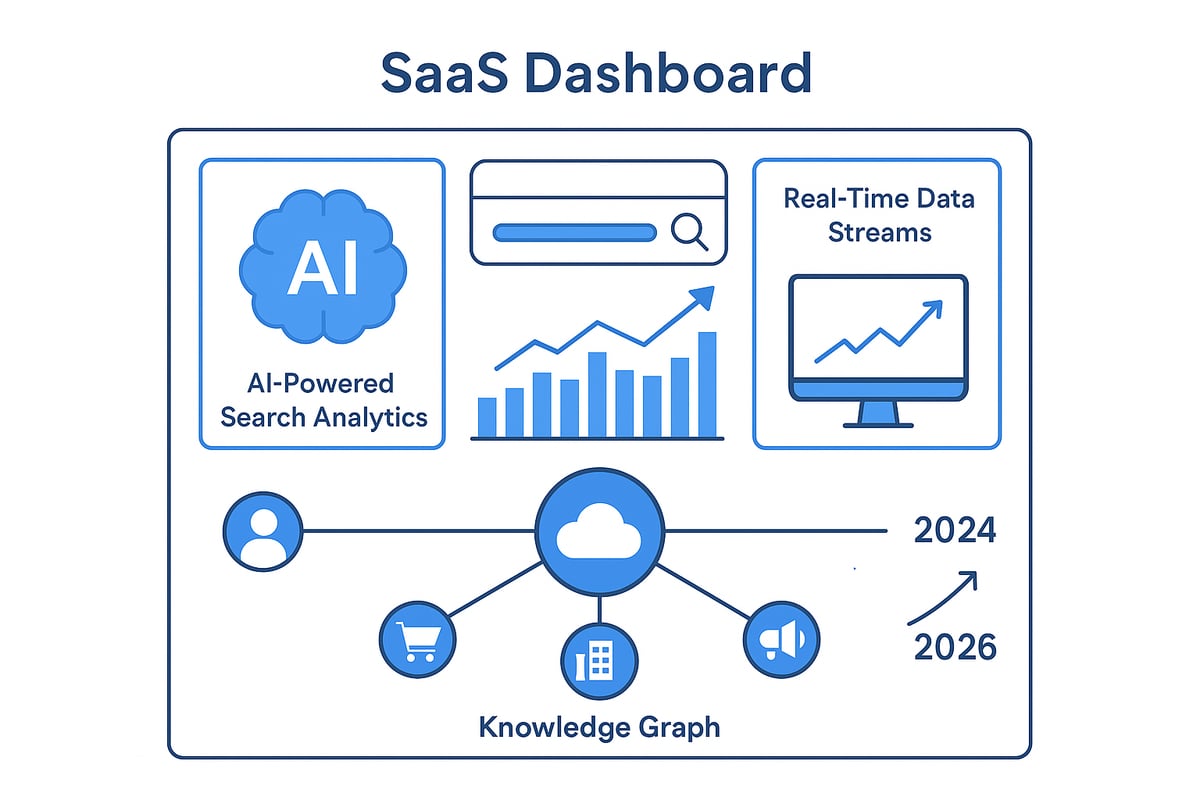
The search saas landscape is undergoing a dramatic transformation between 2024 and 2026. AI is at the center of this evolution, shaping how SaaS platforms are discovered, navigated, and optimized for both users and businesses. Companies are rethinking their strategies to keep pace with these fast-moving changes.
Key Milestones in SaaS Search Development
From 2024 onward, search saas technology has shifted from traditional keyword-based methods toward AI-powered engines. Major platforms such as ChatGPT, Perplexity, and Google AI Overviews have redefined SaaS visibility, relying on prompt-driven and intent-based optimization.
SaaS search platforms are now integrating advanced natural language processing, semantic search, and multi-modal data processing. This enables them to interpret complex queries, regardless of data format or source. Real-time data and daily refresh cycles, as seen with Promptwatch, provide up-to-date search insights, helping companies maintain relevance.
We are also seeing the rise of verticalized search saas solutions tailored for specific industries and use cases. Internal (employee-facing) and external (customer-facing) applications are expanding, with enterprises adopting AI search to unify knowledge across siloed content. For example, a global company can now connect its support, engineering, and compliance teams through a single search interface, boosting productivity and collaboration.
Key developments include:
- Growth of AI-powered search engines and their impact
- Shift to prompt, intent, and context-based optimization
- Integration of NLP, semantic, and multi-modal processing
- Adoption of real-time data refresh for search accuracy
- Verticalized solutions for industry-specific needs
- Expansion of internal vs. external SaaS search functions
These milestones signal a new era for search saas, where agility and intelligence drive competitive advantage.
Changing User Behaviors and Expectations
User expectations for search saas have changed rapidly. Today, users demand instant, accurate results, no matter the data source or format. They expect search experiences that are personalized and contextualized, treating these features as standard.
Transparency is also critical. Users want to understand how and why search results are ranked. This expectation is influencing how SaaS companies design and optimize their search experiences.
Consider the example of customer support engineers. With unified search saas tools, they can instantly locate parts, documentation, and expert contacts across multiple systems. This not only speeds up problem resolution but also improves user satisfaction and operational efficiency.
Current user priorities include:
- Instant, relevant results across all data types
- Personalized and contextualized search experiences
- Clear explanations of result rankings and sources
These shifts are pushing search saas providers to keep user-centricity at the core of their development strategies.
Data & Statistics
The impact of AI-powered search saas is measurable and growing fast. Recent studies show that AI search already accounts for about 2.8% of IT company website traffic. This number is expected to climb to 28% globally by 2027, with SaaS and technology sectors leading the adoption.
SaaS companies are increasingly using multi-engine monitoring to maintain their competitive edge. By tracking performance across multiple AI engines, they can identify new opportunities and threats in real time.
A recent report highlights several key trends:
| Metric | 2024 Value | 2027 Projection |
|---|---|---|
| AI search share of traffic | 2.8% | 28% |
| AI search conversion rate | 4.4x higher | – |
| Companies tracking AI search | 1-2% | – |
For a deeper dive into these trends and statistics, see the AI search statistics and trends for 2026.
These data points reinforce why early adoption of advanced search saas strategies is essential for future growth.
Core Strategies for SaaS Search Success in 2026
Achieving outstanding results in search saas by 2026 demands a blend of unified technology, AI-driven insights, and continuous adaptation. The following core strategies will help your team deliver superior search experiences, secure higher visibility, and outperform competition in the evolving AI-powered landscape.
Building a Unified Search Experience
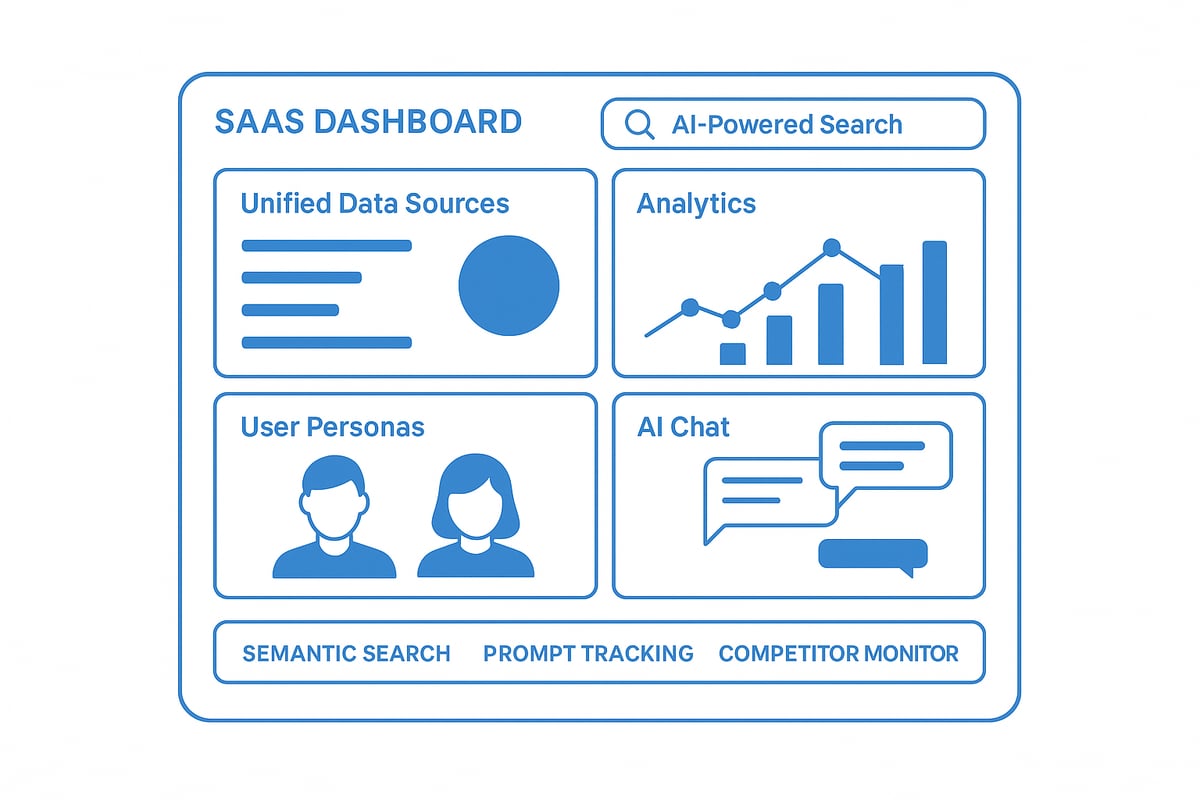
A unified search experience is at the heart of effective search saas strategies. Integrating structured and unstructured data from sources such as databases, cloud applications, and files is essential. This approach ensures both employees and customers can access relevant content instantly.
- Use advanced NLP and semantic search to understand user intent and context.
- Enable internal search for employee knowledge sharing and external search for customer self-service.
- Example: Manufacturing SaaS companies use internal search to connect support, engineering, and compliance teams for faster problem resolution.
Users expect consistent, accurate results regardless of the data’s origin or format. With a unified search saas platform, your organization can break down silos, boost productivity, and deliver seamless information discovery.
AI-Driven Optimization Techniques
AI-driven optimization is transforming search saas effectiveness. Tracking prompt-level performance across engines like ChatGPT, Perplexity, and Gemini is now a must. These insights highlight which prompts drive visibility and where improvement is needed.
- Leverage answer gap analysis to identify missed citation opportunities.
- Implement multi-modal attribution using JavaScript snippets, GSC, and server logs for holistic traffic tracking.
- Example: Promptwatch’s daily refresh cycles and source-level citation tracking provide real-time feedback.
By analyzing prompt performance and answer coverage, search saas teams can fine-tune content and technical factors. This results in higher search impact and better alignment with user needs.
Content and Technical SEO for AI Search
Optimizing content for AI-driven engines is crucial for search saas growth. Focus on real user prompts instead of just keywords. Use entities, schema markup, and structured data to help AI engines understand and rank your content.
- Address technical issues like crawlability, site speed, and accessibility to improve both AI and traditional search performance.
- Example: Writesonic’s Content Strategy Planner helps SaaS teams create content optimized for AI visibility.
- For a deeper dive into AI-driven SEO, see SEO in AI Search for SaaS.
Prioritizing these technical and content factors ensures your search saas solution stands out in an increasingly competitive AI landscape.
Personalization and User Segmentation
Personalization is now table stakes for search saas platforms. Tailor search experiences using persona-driven methodologies. Segment analytics by geography, funnel stage, or customer type to refine targeting.
- Tools like Gumshoe AI leverage buyer personas for more relevant search results.
- Personalization increases engagement and conversion by delivering the right information at the right time.
By segmenting users and adapting search responses, your search saas product becomes more valuable to each audience segment.
Competitive Intelligence and Monitoring
Staying ahead in search saas requires continuous monitoring of competitor presence and sentiment across major AI engines. Multi-engine and multi-geo tracking helps you benchmark performance and spot new opportunities.
- Use platforms like Scrunch AI for broad engine coverage and sentiment analysis.
- Regularly review competitor citations and share of voice to refine your approach.
Competitive intelligence ensures your search saas strategy remains agile and proactive, rather than reactive.
Statistics & Insights
Data-driven decision-making is central to search saas success. Here is a summary of key insights:
| Metric | Value |
|---|---|
| AI search traffic conversion | 4.4x higher than traditional SEO |
| Projected AI search share | 28% of global traffic by 2027 |
| Early adopter advantage | Lasting competitive edge |
Early movers in search saas optimization secure advantages that compound over time. By focusing on these strategies, your team will be positioned to lead in the AI search era.
Selecting and Implementing the Right SaaS Search Technologies
Selecting the right search saas technology is pivotal for long-term visibility and operational agility in an AI-driven world. Today’s SaaS leaders face a fast-moving landscape where technology choices shape both user experience and competitive standing. To guide your decision, this section explores key evaluation criteria, leading platforms, best practices, and real-world examples to ensure your search saas investments deliver measurable results.

Criteria for Choosing SaaS Search Solutions
When evaluating search saas solutions, start by mapping platform capabilities to your organization’s unique needs. Prioritize broad coverage of major AI engines such as ChatGPT, Perplexity, Google AI Overviews, Gemini, and Claude. Comprehensive analytics, including prompt-level tracking, sentiment analysis, and share of voice, are essential for actionable insights.
Scalability is crucial whether you are an enterprise handling multiple brands or a startup aiming for rapid growth. Ensure the search saas platform integrates seamlessly with your existing SEO, analytics, and content workflows. Security, compliance features like SOC 2 and GDPR, and strong data governance should be non-negotiable, particularly for regulated industries.
Ask yourself: does the search saas solution offer real-time data, customizable dashboards, and support for both internal and external search use cases? This alignment will future-proof your investment as AI search evolves.
Leading SaaS Search Platforms and Tools
The current market offers a range of search saas platforms, each with distinct strengths. Here is a comparative table to summarize key features:
| Platform | Core Strengths | Best For |
|---|---|---|
| Promptwatch | Real-time prompt tracking, answer gap analysis | Enterprises, PR, knowledge mgmt |
| Writesonic | AI content creation, actionable SEO insights | Content-driven SaaS |
| Scrunch AI | Multi-engine, persona segmentation, sentiment | Agencies, multi-geo brands |
| SE Ranking | Traditional SEO and AI visibility combined | Cost-conscious, broad coverage |
| Scalenut | Usage-based pricing, AI tracking | Startups, budget-focused |
| Gumshoe AI | Persona-driven strategic insights | SaaS with complex buyer needs |
These search saas solutions support both technical and content optimization, offering prompt monitoring, source-level citation tracking, and integration with analytics. Evaluate the unique strengths of each to match your business objectives.
Implementation Best Practices
Effective implementation ensures your search saas investment translates into tangible outcomes. Begin with a clearly defined use case, such as internal knowledge search or customer support. Set up prompt monitoring and schedule daily or weekly refresh cycles for real-time insights.
Connect your search saas tools to analytics platforms like GA4 and GSC, and pair with technical audit tools for a holistic view. Training teams to interpret AI search data is vital for turning insights into action. For guidance on aligning technical SEO with AI search, see the Guide to SEO and Blogging in the AI Era.
Focus on continuous measurement; review prompt coverage, answer gaps, and user engagement to refine your strategy. This ongoing process helps maximize the value of your search saas platform.
Real-World Examples
Real-world adoption of search saas technologies is accelerating as companies embrace AI-driven search. For instance, a SaaS enterprise used Promptwatch to track the impact of a global PR campaign across multiple AI engines, revealing missed citation opportunities and informing new content initiatives.
Agencies supporting multi-client portfolios leverage Scrunch AI for comprehensive, multi-geo monitoring, ensuring each client stays competitive in their respective markets. These examples highlight how search saas tools deliver practical advantages, from content optimization to competitive intelligence.
With the AI SEO market projected to double from 81 billion dollars in 2024 to 171 billion dollars by 2030, early adoption of search saas platforms positions companies for compounding growth. Yet, only 1 to 2 percent of SaaS companies currently track AI search visibility, signaling a significant opportunity for innovators.
Measuring and Maximizing SaaS Search Impact
In the fast-changing world of search saas, measuring the true impact of your efforts is more critical than ever. As AI-driven search platforms reshape how users discover and interact with SaaS products, leaders must adopt a data-driven approach to track performance, optimize strategies, and stay ahead of the competition.
Key Metrics for SaaS Search Performance
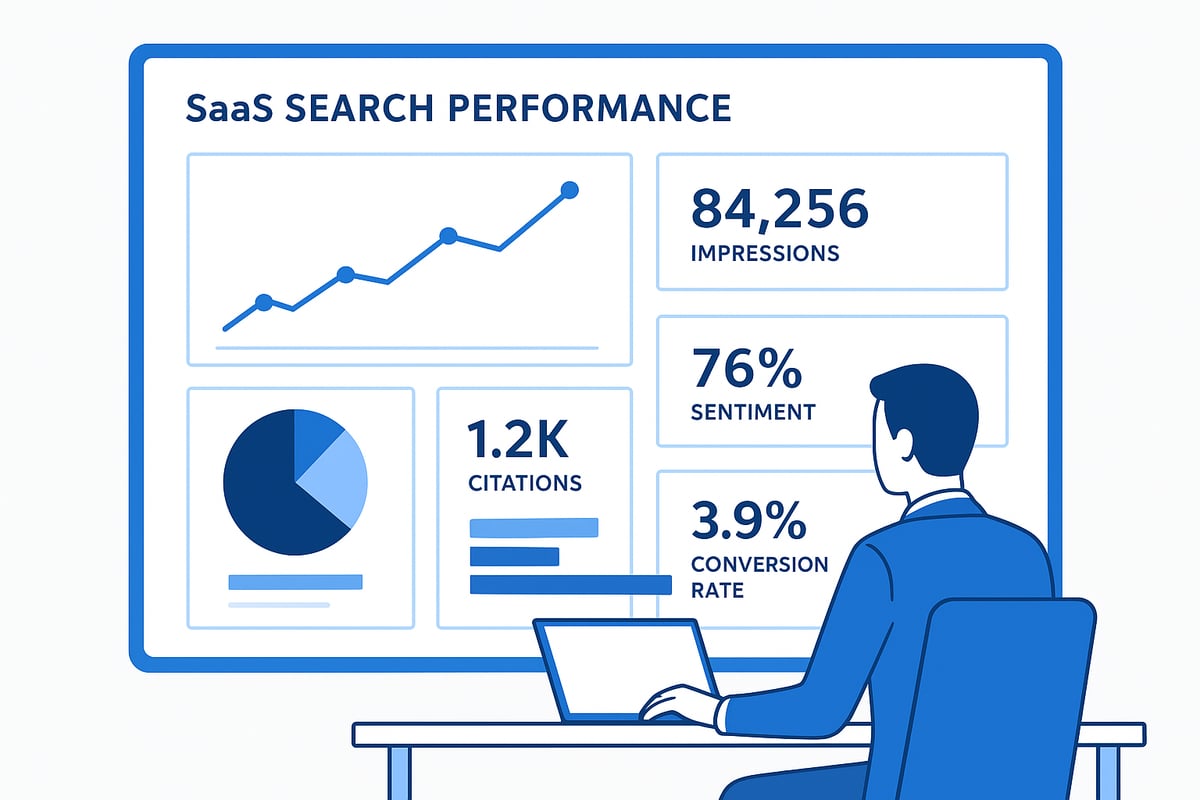
To succeed in the search saas landscape, tracking the right metrics is essential. Traditional SEO metrics are no longer enough. Forward-thinking teams now focus on AI-specific indicators to gauge visibility and effectiveness.
Core Metrics Table:
| Metric | Description | Why It Matters |
|---|---|---|
| AI Search Impressions | Times your SaaS is surfaced in AI results | Measures reach |
| Prompt Coverage | Share of relevant prompts answered by your brand | Identifies gaps |
| Citation Frequency | How often your brand is cited in AI responses | Tracks authority |
| Share of Voice | Brand presence vs. competitors in AI search | Benchmarks performance |
| Sentiment Analysis | Tone of mentions in AI-generated content | Monitors brand health |
| AI-driven Traffic Attribution | Visitors traced to AI-powered search | Measures real impact |
| Conversion Rates | Percentage of AI search-driven users who convert | Ties to business results |
Teams should also monitor engagement metrics such as time to information, user satisfaction scores, and support ticket reduction. As AI Overviews’ impact on search in 2025 shows, tracking these new data points helps SaaS companies adapt to evolving search behaviors and maintain strong visibility.
Attribution Models and Analytics
Attribution in search saas is increasingly complex. With users arriving from diverse AI engines, chatbots, and multi-modal platforms, mapping the full customer journey requires a multi-layered approach.
Best Practices for Attribution:
- Combine JavaScript tags, server logs, and Google Search Console for comprehensive tracking.
- Attribute AI search-driven visits using unique UTM parameters and referral data.
- Integrate prompt-level analytics to identify which queries trigger your citations.
A major challenge is connecting AI search visibility directly to closed sales. Often, analytics provide directional insights rather than absolute ROI. Use this data to guide content, PR, and product investments, rather than relying on exact figures.
For deeper analysis, consider:
- Answer gap analysis to reveal missed opportunities.
- Sentiment tracking to monitor brand perception.
- Benchmarking share of voice against competitors.
These analytics frameworks enable agile, data-driven decision-making within the search saas environment.
Benchmarking and Continuous Optimization
Benchmarking is vital for search saas teams aiming to drive ongoing results. Establish baseline metrics for AI search presence, then monitor changes over time to spot trends and gaps.
Continuous Optimization Steps:
- Audit technical and content factors influencing AI rankings.
- Use answer/content gap analysis to inform new content and product features.
- Regularly review support metrics to measure efficiency gains from unified search.
Real-World Use Cases:
- A SaaS company identifies missed citations and launches targeted content to fill those gaps, resulting in improved prompt coverage.
- Support teams report significant reductions in average resolution time after implementing unified search, directly impacting user satisfaction.
Data shows that AI search optimization leads to 4.4x higher conversion rates than traditional SEO. Early adopters leveraging tools and AI-powered analytics, such as those highlighted in Using AI Marketing Tools for SaaS, are positioned to outpace competitors.
By measuring, benchmarking, and optimizing every aspect of search saas strategy, digital teams can drive sustained growth and future-proof their approach in a rapidly evolving digital landscape.
Future Trends and Predictions for SaaS Search in 2026 and Beyond
The future of search saas is defined by rapid innovation, shifting user habits, and new technology frontiers. As we look ahead to 2026 and beyond, SaaS leaders must anticipate these changes to remain competitive. The trends below will shape how search saas platforms evolve, how users interact with information, and how businesses measure success.
AI-First Search and the Rise of Conversational Interfaces
AI-first search saas platforms are transforming the way users access information. Instead of relying solely on traditional search engines, users are increasingly engaging with conversational interfaces such as chatbots, virtual agents, and voice assistants. According to Gartner predicts 25% drop in search volume by 2026, traditional search volume is expected to decline as AI-driven solutions take center stage.
AI agents act as intermediaries, understanding natural language prompts and delivering precise answers. This shift means search saas providers must optimize for multi-modal experiences, ensuring their content is discoverable by both humans and bots. The rise of "shadow sites" designed for bots highlights the need for new technical strategies.
Hyper-Personalization and Adaptive Search
Personalization is becoming a standard expectation for search saas users. Platforms are leveraging AI to adapt search results in real time based on user behavior, intent, and context. Dynamic segmentation ensures that each persona receives relevant, actionable information, regardless of device or location.
With hyper-personalization, search saas solutions can anticipate needs, present tailored recommendations, and streamline workflows. This adaptive approach not only boosts user satisfaction but also drives higher engagement and retention rates, setting the stage for long-term success.
Integration with Business Intelligence and Automation
The integration of search saas with business intelligence tools and automation is unlocking new opportunities for data-driven growth. Search analytics now inform product development, customer success, and sales enablement, bridging the gap between discovery and action.
Automated workflow triggers, powered by AI search insights, enable faster response times and more efficient operations. By embedding search saas data into broader business processes, organizations can create a feedback loop that continuously improves both the user experience and business outcomes.
Expanding Use Cases and Industry Verticals
Search saas is rapidly expanding into specialized use cases and industry verticals. Solutions tailored for compliance, healthcare, manufacturing, and legal are gaining traction, providing industry-specific insights and capabilities. The rise of verticalized search strategies, as explored in Vertical SaaS Validation Strategies, demonstrates how customization is key to meeting unique sector needs.
As demand grows, search saas providers are developing tools for B2B SaaS, e-commerce, and customer support, creating a diverse ecosystem of targeted solutions that address complex requirements.
Data Privacy, Ethics, and Trust
With the increasing adoption of AI in search saas, concerns around data privacy, ethics, and trust are coming to the forefront. Regulatory scrutiny is rising, and users expect transparent, explainable algorithms and greater control over their information.
SaaS companies must prioritize compliance with global standards, such as SOC 2 and GDPR, while building systems that foster trust. Transparent ranking logic, user controls, and ethical data practices will be essential for maintaining credibility and customer loyalty in the evolving search saas landscape.
Statistics & Forward-Looking Data
The future of search saas is bright, with market data highlighting significant growth and opportunity. Consider the following projections:
| Metric | 2024 | 2026 | 2028 |
|---|---|---|---|
| AI Search Share of SaaS Traffic | 2.8% | 28% | 30%+ |
| AI SEO Market Size (USD) | $81B | $126B* | $171B |
| Traditional Search Volume Decline | – | -25%* | – |
*Estimates based on current trends and industry reports.
Early adoption of AI search saas optimization is a critical differentiator. Companies investing now are likely to benefit from compounding competitive advantages, positioning themselves as market leaders in the years ahead.